<?xml version="1.0" encoding="UTF-8"?>
<?xml-stylesheet type="text/xsl" href="/wp-content/themes/feed/atom.xsl"?>
<feed
        xmlns="http://www.w3.org/2005/Atom"
        xmlns:wwe="http://release.wwe.com/atom/1.0"
        xmlns:thr="http://purl.org/syndication/thread/1.0"
        xmlns:taxo="http://purl.org/rss/1.0/modules/taxonomy/"
        xml:lang="en-US"
        xml:base="https://www.adamwillmanlaw.com/wp-atom.php"
	>
    <title type="text">Law Office Of Adam J. Willman</title>
    <subtitle type="text">Law Office Of Adam J. Willman</subtitle>

    <updated>2026-05-19T13:16:23Z</updated>

    <link rel="alternate" type="text/html" href="https://www.adamwillmanlaw.com" />
    <id>https://www.adamwillmanlaw.com/feed/atom/</id>
    <link rel="self" type="application/atom+xml" href="https://www.adamwillmanlaw.com/feed/atom/?forceByPassCache=0.18240755812603127" />
	
	<generator uri="https://wordpress.org/" version="6.9.5">WordPress</generator>
<icon>/wp-content/uploads/sites/1405041/2020/01/cropped-favicon-1-32x32.png</icon>
        <entry>
            <author>
									                    <name>On Behalf of Law Office of Adam J. Willman</name>
				            </author>
            <title type="html"><![CDATA[How might an underage DWI affect a teen&#8217;s future?]]></title>
            <link rel="alternate" type="text/html" href="https://www.adamwillmanlaw.com/blog/2026/05/how-might-an-underage-dwi-affect-a-teens-future/" />
            <id>https://www.adamwillmanlaw.com/?p=48580</id>
            <updated>2026-05-19T13:16:23Z</updated>
            <published>2026-05-19T13:16:23Z</published>
					<taxo:topics><![CDATA[-]]></taxo:topics>
            <summary type="html"><![CDATA[Few phone calls are more frightening for a parent than those that relay a message that their teenager has been arrested for driving while intoxicated. The fear that roots this experience is understandable. After all, a conviction may affect a young person’s criminal record, educational opportunities, employment prospects and future independence.  New York recognizes multiple classifications for minors involved in…]]></summary>
			                <content type="html" xml:base="https://www.adamwillmanlaw.com/blog/2026/05/how-might-an-underage-dwi-affect-a-teens-future/"><![CDATA[<span style="font-weight: 400">Few phone calls are more frightening for a parent than those that relay a message that their teenager has been arrested for driving while intoxicated. The fear that roots this experience is understandable. After all, a conviction may affect a young person’s criminal record, educational opportunities, employment prospects and future independence. </span>

<span style="font-weight: 400">New York recognizes multiple classifications for minors involved in criminal matters. Juvenile Delinquents are generally children between the ages of 7 and 17 who commit offenses but are handled in family court rather than adult criminal court. Importantly, Juvenile Delinquents are not generally impacted by criminal convictions or criminal records.</span>

<span style="font-weight: 400">However, older teens may face more serious exposure. </span><a href="https://www.nycourts.gov/help/criminal/youthful-offenders" target="_blank" rel="noopener noreferrer" data-wpel-link="external"><span style="font-weight: 400">Youthful Offender status</span></a><span style="font-weight: 400"> may apply to certain defendants who are at least 16 years old and under 19 at the time of an alleged offense. Youthful Offender adjudications are not considered criminal convictions and can help protect a teenager’s future from the long-term consequences of a public criminal record.</span>

<span style="font-weight: 400">Adolescent Offenders are generally 16- and 17-year-olds charged with certain felony-level offenses under New York’s Raise the Age laws. Depending on the allegations at issue, these cases may begin in criminal court. In some situations, criminal records can become a serious concern if Youthful Offender protections are not granted.</span>
<h2><span style="font-weight: 400">Potential penalties upon conviction</span></h2>
<span style="font-weight: 400">Underaged DWI charges may result in significant penalties. New York’s “zero tolerance” law applies to drivers under age 21 operating a vehicle with a blood alcohol content between .02% and .07%. Administrative penalties may include license suspension, civil fines and mandatory fees.</span>

<span style="font-weight: 400">If a driver under 21 has a BAC of .08% or higher, </span><a href="https://dmv.ny.gov/brochure/c-12.pdf" target="_blank" rel="noopener noreferrer" data-wpel-link="external"><span style="font-weight: 400">standard DWI charges may apply</span></a><span style="font-weight: 400">. These criminal charges can lead to fines, probation, mandatory alcohol education programs, license revocation and even possible jail exposure in some situations. A criminal conviction may also affect college admissions, scholarships, internships and future employment opportunities.</span>

<span style="font-weight: 400">Additional reckless driving behaviors can worsen the situation substantially. Speeding, racing, causing an accident, possessing drugs or having passengers in one’s vehicle at the time of an alleged offense may lead to additional criminal charges and harsher penalties depending on the court’s findings. </span>

<span style="font-weight: 400">Parents should also understand that prosecutors and courts may treat repeat offenses much more aggressively. Early intervention and strong legal representation may help protect a teenager’s future and identify opportunities to pursue reduced charges or alternative outcomes.</span>

<span style="font-weight: 400">Teenagers sometimes make impulsive decisions without fully understanding the potential consequences of their actions. That does not mean one mistake should permanently define their future. If your child is facing DWI charges or other reckless driving allegations in New York, know that contacting an </span><a href="/dwi/" target="_blank" rel="noopener" data-wpel-link="internal"><span style="font-weight: 400">experienced criminal defense law firm</span></a><span style="font-weight: 400"> as soon as possible may help protect their rights, record and long-term opportunities.</span>]]></content>
						        </entry>
	        <entry>
            <author>
									                    <name>On Behalf of Law Office of Adam J. Willman</name>
				            </author>
            <title type="html"><![CDATA[How does the Sex Offender Registry Work?]]></title>
            <link rel="alternate" type="text/html" href="https://www.adamwillmanlaw.com/blog/2026/04/how-does-the-sex-offender-registry-work/" />
            <id>https://www.adamwillmanlaw.com/?p=48577</id>
            <updated>2026-04-20T15:30:25Z</updated>
            <published>2026-04-20T11:57:15Z</published>
					<taxo:topics><![CDATA[-]]></taxo:topics>
            <summary type="html"><![CDATA[The Sex Offender Registration Act requires people who are convicted of specific sex-related offenses to report personal information to the state. They must ensure they keep the information updated. In New York, the sex offender registry is maintained by the Division of Criminal Justice Services.  Sex offender registration isn’t a one-time event. It requires that a person continue reporting for…]]></summary>
			                <content type="html" xml:base="https://www.adamwillmanlaw.com/blog/2026/04/how-does-the-sex-offender-registry-work/"><![CDATA[<span style="font-weight: 400">The Sex Offender Registration Act requires people who are convicted of specific sex-related offenses to report personal information to the state. They must ensure they keep the information updated. In New York, the sex offender registry is maintained by the Division of Criminal Justice Services. </span>

<a href="https://www.criminaljustice.ny.gov/nsor/faq.htm" data-wpel-link="external" target="_blank" rel="noopener noreferrer"><span style="font-weight: 400">Sex offender registration</span></a><span style="font-weight: 400"> isn’t a one-time event. It requires that a person continue reporting for a specific time period, up to life. Understanding how the registry works is critical for anyone who’s facing a sex-related charge or who has already been convicted.</span>
<h2><span style="font-weight: 400">What are the risk levels and registration periods for the registry?</span></h2>
<span style="font-weight: 400">There are </span><a href="https://www.criminaljustice.ny.gov/nsor/risk_levels.htm" data-wpel-link="external" target="_blank" rel="noopener noreferrer"><span style="font-weight: 400">three risk levels</span></a><span style="font-weight: 400"> that are used in New York. These are determined by the offense and other factors that are related to the likelihood of the person reoffending and the need to alert the public about the individual. </span>

<span style="font-weight: 400">Level 1 is the lowest risk level and usually requires the person to remain on the registry for at least 20 years. It’s possible that certain special designations, such as being a sexually violent offender, sexual predator or predatory sex offender, can trigger a lifetime registration requirement. Level 1 offenders usually aren’t listed on the public-facing registry.</span>

<span style="font-weight: 400">Level 2 is a moderate risk, while Level 3 is a high risk. Both of these risk levels require lifetime registration, but some of those on Level 2 can petition for a reconsideration after 30 years, as long as they don’t have a special designation. Individuals who are classified as Level 2 or Level 3 are listed on the public-facing sex offender registry.</span>

<span style="font-weight: 400">Life on the sex offender registry can affect a variety of areas of the individual’s life, including housing and employment. Even if a person isn’t on the public-facing registry, it can still show up on background checks. Local rules and supervision terms can also affect the individual. They also have to abide by restrictions related to schools, vulnerable populations and conditions of parole. </span>

<span style="font-weight: 400">It’s critical for anyone <a href="https://www.adamwillmanlaw.com/blog/2026/03/crucial-updates-on-the-drivers-license-point-system-in-new-york/" data-wpel-link="internal">facing </a></span><span style="font-weight: 400">sex crime charges</span><span style="font-weight: 400"> to understand their defense options. Working with someone familiar with these matters is advised so they can get the information and assistance they need. </span>

&nbsp;]]></content>
						        </entry>
	        <entry>
            <author>
									                    <name>On Behalf of Law Office of Adam J. Willman</name>
				            </author>
            <title type="html"><![CDATA[Crucial updates on the driver’s license point system in New York]]></title>
            <link rel="alternate" type="text/html" href="https://www.adamwillmanlaw.com/blog/2026/03/crucial-updates-on-the-drivers-license-point-system-in-new-york/" />
            <id>https://www.adamwillmanlaw.com/?p=48570</id>
            <updated>2026-03-17T21:44:28Z</updated>
            <published>2026-03-17T14:09:59Z</published>
					<taxo:topics><![CDATA[-]]></taxo:topics>
            <summary type="html"><![CDATA[Getting a ticket used to be a headache, but as of February 16, 2026, New York State has made it a much more serious threat to your livelihood. Under the new overhaul of the Driver Violation Point System, the safety net for your license just got a lot smaller. Increased point values The Department of Motor Vehicles (DMV) significantly raised…]]></summary>
			                <content type="html" xml:base="https://www.adamwillmanlaw.com/blog/2026/03/crucial-updates-on-the-drivers-license-point-system-in-new-york/"><![CDATA[Getting a ticket used to be a headache, but as of February 16, 2026, New York State has made it a much more serious threat to your livelihood. Under the new overhaul of the Driver Violation Point System, the safety net for your license just got a lot smaller.
<h2>Increased point values</h2>
The Department of Motor Vehicles (DMV) significantly <a href="https://dmv.ny.gov/news/dmv-reminds-new-yorkers-of-updated-point-values-for-driving-violations" target="_blank" rel="noopener noreferrer" data-wpel-link="external">raised the point values</a> assigned to certain dangerous behaviors. Some violations that previously carried no points now have the maximum amount, making it possible to lose a license after just one or two incidents.

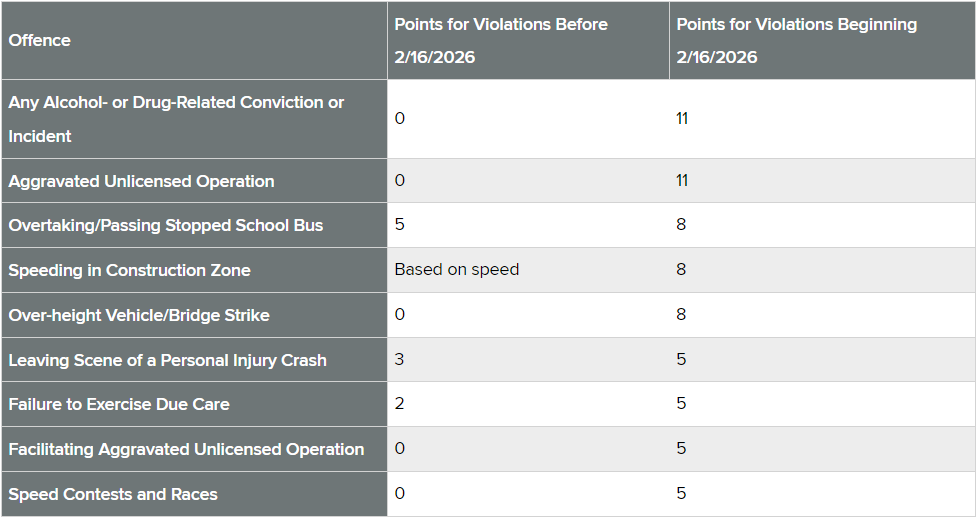
For instance, any alcohol or drug-related conviction or incident increased from zero to 11 points. Meanwhile, passing a stopped school bus has jumped from five to eight points.

<span style="font-size: 10pt;"><strong><em>*Chart from the New York State DMV website.</em></strong></span><img class="alignnone size-full wp-image-48572" src="/wp-content/uploads/sites/1405041/2026/03/DMV-Points-Change-2026.png" alt="Grid displaying the changes of the Drivers License Point changes in New York State, 2026." width="977" height="517" />
<h2>New lookback period</h2>
Previously, the DMV looked at your driving record over an 18-month window to determine if you reached the 11-point threshold for a formal license suspension hearing. The new regulations extended this lookback period to 24 months. This extension means points shadow your record longer, making it easier for the DMV to flag persistent violators.
<h2>The consequences of accumulated points</h2>
A single <a href="https://www.adamwillmanlaw.com/traffic-violations/" target="_blank" rel="noopener" data-wpel-link="internal">traffic violation</a> can make a difference in your record, especially if the offense is equivalent to eleven points. You could face a license suspension or revocation, depending on the severity of the ticket. While this mainly affects your commute, it heavily impacts your livelihood.

Because your future is at stake, leaving it to chance is too risky. Seeking legal counsel is wise to learn more about your options for resolving the matter.]]></content>
						        </entry>
	        <entry>
            <author>
									                    <name>On Behalf of Law Office of Adam J. Willman</name>
				            </author>
            <title type="html"><![CDATA[When is drug possession a misdemeanor?]]></title>
            <link rel="alternate" type="text/html" href="https://www.adamwillmanlaw.com/blog/2026/01/when-is-drug-possession-a-misdemeanor/" />
            <id>https://www.adamwillmanlaw.com/?p=47975</id>
            <updated>2026-01-16T13:33:21Z</updated>
            <published>2026-01-16T13:33:21Z</published>
					<taxo:topics><![CDATA[-]]></taxo:topics>
            <summary type="html"><![CDATA[New York criminalizes many substances and has rules controlling the use and distribution of many others. Both prohibited drugs and controlled substances that require a physician’s recommendation can be the cause of a drug charge. Individuals accused of relatively serious drug offenses, including manufacturing or trafficking drugs, typically face felony charges. However, possession offenses are different. They are wobbler offenses…]]></summary>
			                <content type="html" xml:base="https://www.adamwillmanlaw.com/blog/2026/01/when-is-drug-possession-a-misdemeanor/"><![CDATA[New York criminalizes many substances and has rules controlling the use and distribution of many others. Both prohibited drugs and controlled substances that require a physician's recommendation can be the cause of a drug charge.

Individuals accused of relatively serious drug offenses, including manufacturing or trafficking drugs, typically face felony charges. However, possession offenses are different. They are wobbler offenses that can lead to either misdemeanor or felony charges, depending on the details of the situation.

Anyone recently arrested for a drug offense may feel anxious about the future. They may worry about the prosecutor bringing the harshest charges possible. When are drug defendants likely to face misdemeanor charges instead of a felony charge?
<h2>The details determine how the state responds</h2>
There are two important considerations that have a profound impact on drug charges in New York. The amount of drugs, as determined by their overall weight, is often the most pressing factor. The weight of the drugs found by police officers is typically the main factor that determines whether a drug possession offense is a misdemeanor or a felony. Most of the time, misdemeanor drug offenses are <a href="https://www.nysenate.gov/legislation/laws/PEN/220.03" data-wpel-link="external" target="_blank" rel="noopener noreferrer">Class A misdemeanor charges</a>. Defendants may face up to a year in prison, as well as up to $1,000 in fines.

State laws include thresholds for different drugs. Any amount over the established threshold for possession could potentially lead to a felony charge. Those with lesser amounts of drugs may potentially face misdemeanor charges.

However, in such cases, the other main factor comes into play. The state also looks at the history of the person charged with the drug offense. Prior offenses involving drugs can potentially increase the severity of the charges or may inspire the courts to hand down harsher sentences based on the guidelines included in state statutes.

Anyone accused of a possession offense may need to review the situation carefully to develop the best possible legal strategy for minimizing the chances of a conviction or reducing the long-term consequences that the defendant faces. Some defendants can suppress evidence, while others could request drug court proceedings. Having insight into the law while navigating the criminal justice system can make a major difference for those hoping to minimize the impact of a <a href="https://www.adamwillmanlaw.com/drug-violations/" data-wpel-link="internal">recent drug arrest</a>.]]></content>
						        </entry>
	        <entry>
            <author>
									                    <name>On Behalf of Law Office of Adam J. Willman</name>
				            </author>
            <title type="html"><![CDATA[What happens after refusing a breathalyzer test in New York?]]></title>
            <link rel="alternate" type="text/html" href="https://www.adamwillmanlaw.com/blog/2025/10/what-happens-after-refusing-a-breathalyzer-test-in-new-york/" />
            <id>https://www.adamwillmanlaw.com/?p=47969</id>
            <updated>2025-10-06T09:58:27Z</updated>
            <published>2025-10-06T09:58:27Z</published>
					<taxo:topics><![CDATA[Criminal Defense]]></taxo:topics>
            <summary type="html"><![CDATA[Refusing a breathalyzer test in New York carries immediate consequences. Many drivers wonder about their options when facing a police officer’s request for this test during a suspected impaired driving stop. The role of the breathalyzer in DUI cases A breathalyzer test measures your blood alcohol content (BAC) from a breath sample. Police use this crucial tool to gather evidence…]]></summary>
			                <content type="html" xml:base="https://www.adamwillmanlaw.com/blog/2025/10/what-happens-after-refusing-a-breathalyzer-test-in-new-york/"><![CDATA[Refusing a breathalyzer test in New York carries immediate consequences. Many drivers wonder about their options when facing a police officer's request for this test during a suspected impaired driving stop.
<h2>The role of the breathalyzer in DUI cases</h2>
A breathalyzer test measures your blood alcohol content (BAC) from a breath sample. Police use this crucial tool to gather evidence of impaired driving. New York law considers a BAC of 0.08% or higher as legally intoxicated for most drivers. This simple test provides immediate data supporting a driving while intoxicated (DWI) charge.
<h2>What is the cost of refusal?</h2>
New York has an<a href="https://www.findlaw.com/dui/arrests/can-i-refuse-a-breathalyzer-test.html" data-wpel-link="external" target="_blank" rel="noopener noreferrer"> implied consent law</a>. This means you automatically agree to a chemical test if an officer lawfully arrests you for DWI. Refusing this test triggers separate, harsh penalties, even if authorities never prove your intoxication. These consequences are immediate and impact your driving privileges significantly. Potential penalties for refusing a breathalyzer test include:
<ul>
 	<li><strong>License revocation:</strong> Your driver's license is immediately suspended at your arraignment, and the DMV will revoke it for at least one year.</li>
 	<li><strong>Civil penalties:</strong> You face a civil penalty of at least $500.</li>
 	<li><strong>DWI penalties:</strong> These penalties come in addition to any penalties for a DWI conviction.</li>
 	<li><strong>Increased insurance rates:</strong> Your insurance company will likely view a refusal as a high-risk factor.</li>
</ul>
Refusing a breathalyzer adds another layer of legal difficulty to a DWI case.
<h2>Understanding the legal complications</h2>
Facing a DWI charge and a breathalyzer refusal can be overwhelming. You need someone who understands the nuances of New York's implied consent laws and how these cases proceed in local courts. A skilled attorney can explain your specific situation and <a href="https://www.adamwillmanlaw.com/dwi/" data-wpel-link="internal">advocate on your behalf</a>. They help you understand your rights, challenge evidence and work towards a more positive possible outcome for your future.

&nbsp;]]></content>
						        </entry>
	        <entry>
            <author>
									                    <name>On Behalf of Law Office of Adam J. Willman</name>
				            </author>
            <title type="html"><![CDATA[What are the legal risks of sharing prescription medication?]]></title>
            <link rel="alternate" type="text/html" href="https://www.adamwillmanlaw.com/blog/2025/08/what-are-the-legal-risks-of-sharing-prescription-medication/" />
            <id>https://www.adamwillmanlaw.com/?p=47965</id>
            <updated>2025-08-04T12:33:04Z</updated>
            <published>2025-08-04T12:33:04Z</published>
					<taxo:topics><![CDATA[-]]></taxo:topics>
            <summary type="html"><![CDATA[Prescription medication isn’t cheap. Even people with decent health insurance often have co-pays or deductibles that force them to pay for their medication. They may have to choose between a generic drug and paying out of pocket for brand-name medication. If a patient does not use all of the medication that they acquire at the pharmacy, they may want to…]]></summary>
			                <content type="html" xml:base="https://www.adamwillmanlaw.com/blog/2025/08/what-are-the-legal-risks-of-sharing-prescription-medication/"><![CDATA[Prescription medication isn't cheap. Even people with decent health insurance often have co-pays or deductibles that force them to pay for their medication. They may have to choose between a generic drug and paying out of pocket for brand-name medication.

If a patient does not use all of the medication that they acquire at the pharmacy, they may want to recover some of what they spent or put the medication that they have on hand to use. Obviously, the act of selling leftover medication to others could lead to criminal prosecution. People without appropriate licenses cannot sell medication to others.

<a href="https://pmc.ncbi.nlm.nih.gov/articles/PMC10983120/" data-wpel-link="external" target="_blank" rel="noopener noreferrer">Sharing or giving away medication</a> could seem like a reasonable alternative. Those who are aware that their co-workers, neighbors or family members may require the same medication that they use might consider giving away any leftover medication they have. Unfortunately, doing so could put the generous person trying to help others at risk of criminal prosecution.
<h2>Any transfer could constitute distribution</h2>
A financial exchange is not necessary for the state to accuse an individual of drug distribution or trafficking. Instead, there simply needs to be evidence affirming the allegation that one person without appropriate licensing transferred medication to another individual.

Even if the recipient has a valid prescription, it is still illegal to give away extra medication to that person. Despite being aware of an individual's medical challenges and asserting that the transfer is for <a href="https://pmc.ncbi.nlm.nih.gov/articles/PMC10983120/" data-wpel-link="external" target="_blank" rel="noopener noreferrer">medicinal, not recreational, purposes</a>, the party supplying the medication is at risk of prosecution.

Getting caught in the act isn't the only way for legal complications to arise. There's also the potential risk of the recipient causing a car crash or committing a crime while they are under the influence. They might then disclose to law enforcement professionals where they obtained the medication. Similarly, if the recipient has an adverse reaction or overdoses, law enforcement professionals are likely to investigate the source of the medication that caused their issues.

Realizing that well-intentioned behavior could lead to <a href="https://www.adamwillmanlaw.com/drug-violations/" data-wpel-link="internal">drug charges</a> can help people avoid life-altering mistakes. Those accused of a drug offense related to sharing prescription medication may need help responding in a manner that limits the lasting consequences of the charges at issue, and that’s okay.

&nbsp;]]></content>
						        </entry>
	        <entry>
            <author>
									                    <name>On Behalf of Law Office of Adam J. Willman</name>
				            </author>
            <title type="html"><![CDATA[What are the standardized field sobriety tests?]]></title>
            <link rel="alternate" type="text/html" href="https://www.adamwillmanlaw.com/blog/2025/04/what-are-the-standardized-field-sobriety-tests/" />
            <id>https://www.adamwillmanlaw.com/?p=47962</id>
            <updated>2025-04-22T17:31:31Z</updated>
            <published>2025-04-22T17:31:31Z</published>
					<taxo:topics><![CDATA[-]]></taxo:topics>
            <summary type="html"><![CDATA[During a drunk driving traffic stop, police officers document the situation to build a criminal case. They may follow a driver who seems intoxicated for several blocks recording their performance at the wheel. They may ask drivers questions that could implicate them. When they have strong suspicions of intoxication, they may ask a motorist to step out of their vehicle…]]></summary>
			                <content type="html" xml:base="https://www.adamwillmanlaw.com/blog/2025/04/what-are-the-standardized-field-sobriety-tests/"><![CDATA[During a drunk driving traffic stop, police officers document the situation to build a criminal case. They may follow a driver who seems intoxicated for several blocks recording their performance at the wheel. They may ask drivers questions that could implicate them.

When they have strong suspicions of intoxication, they may ask a motorist to step out of their vehicle and perform field sobriety tests. Field sobriety tests can provide the basis for criminal charges. A driver's performance on these tests could give the state evidence to use against them during a criminal trial.

To ensure that the evidence gathered through field sobriety testing is reliable and useful in criminal court, police officers must adhere to best practices. Typically, they can only administer the three standardized field sobriety tests. What tests can officers have drivers perform?
<h2>1. The walk-and-turn test</h2>
Chemical intoxication can affect motor control and balance. Asking drivers to walk in a straight line, turn around, and walk in a straight line again can expose signs of impaired physical abilities.

<a href="https://www.verywellmind.com/field-sobriety-test-67159" data-wpel-link="external" target="_blank" rel="noopener noreferrer">The walk-and-turn test</a> looks at gait and balance. Drivers who cannot walk in a straight line or who stumble while turning may be at risk of arrest and prosecution.
<h2>2. The one-leg stand test</h2>
It is also common practice for police officers to have drivers they suspect of intoxication stand on one leg. Maintaining balance on one leg requires muscular control and focus. Of course, there are a host of other issues, ranging from naturally poor equilibrium to anxiety, that can affect a motorist’s performance on this test.
<h2>3. The horizontal gaze nystagmus test</h2>
Alcohol doesn't just affect cognition and physical abilities. It can also impact subconscious physical activities as well.

Officers trying to determine if a driver is under the influence may ask them to follow their fingers or a small light without moving their head. The goal of this test is to watch for a muscle spasm when the eyes move laterally. That spasm exists regardless of circumstances, but it becomes much more visible in cases where people are under the influence of alcohol.

Field sobriety tests are not mandatory during a driving while intoxicated (DWI) traffic stop. They are also far from infallible. There are many reasons that people might fail field sobriety tests that have nothing to do with intoxication.

Learning more about how police officers gather evidence of impaired driving can be beneficial for those hoping to fight <a href="/dwi/" data-wpel-link="internal">upcoming DWI charges</a>. Motorists who can provide an alternate explanation for their field sobriety test results may be able to avoid a conviction when accused of drunk driving.]]></content>
						        </entry>
	        <entry>
            <author>
									                    <name>On Behalf of Law Office of Adam J. Willman</name>
				            </author>
            <title type="html"><![CDATA[When can the state pursue constructive drug possession charges?]]></title>
            <link rel="alternate" type="text/html" href="https://www.adamwillmanlaw.com/blog/2025/01/when-can-the-state-pursue-constructive-drug-possession-charges/" />
            <id>https://www.adamwillmanlaw.com/?p=47959</id>
            <updated>2025-01-24T02:06:07Z</updated>
            <published>2025-01-24T02:06:07Z</published>
					<taxo:topics><![CDATA[-]]></taxo:topics>
            <summary type="html"><![CDATA[Most drug possession charges are straightforward legal issues. In some scenarios, police officers may discover an individual in physical possession of a drug or under its influence. The accused person may have prescription medication for which they do not have documentation or a prohibited drug in their pockets or otherwise directly under their control. The evidence gathered by police officers…]]></summary>
			                <content type="html" xml:base="https://www.adamwillmanlaw.com/blog/2025/01/when-can-the-state-pursue-constructive-drug-possession-charges/"><![CDATA[Most drug possession charges are straightforward legal issues. In some scenarios, police officers may discover an individual in physical possession of a drug or under its influence. The accused person may have prescription medication for which they do not have documentation or a prohibited drug in their pockets or otherwise directly under their control. The evidence gathered by police officers may make it simple for the state to pursue criminal charges based on actual possession of drugs.

Occasionally, those accused of a drug offense face allegations based on constructive possession rather than actual possession. People who understand what constructive possession is may be able to develop a more effective response to pending drug charges.
<h2>What is constructive possession?</h2>
<a href="https://www.nycourts.gov/judges/cji/2-PenalLaw/220/AC.220.Constructive_Possession.pdf" data-wpel-link="external" target="_blank" rel="noopener noreferrer">Constructive possession</a> occurs when an individual has awareness of and control over drugs. While the drugs aren't on their person, there is clear evidence indicating they are the owner or the party in control of the drug.

Police officers may have found the drugs under the seat of a vehicle with multiple occupants or inside a residence during a social gathering. If no one admits to owning the drug, then police officers may arrest someone based on suspicions of constructive possession.

They determine by proximity, access and even prior criminal records who is most likely to actually own and control the drugs. That individual may then face drug possession charges.
<h2>How do people fight claims of constructive possession?</h2>
There are several strategies that can help people challenge allegations of constructive possession. In some cases, there might be forensic evidence, such as fingerprints, that indicate a different individual may have been the actual owner in control of the drugs that police officers found. Other times, a lack of forensic evidence could help raise a reasonable doubt about whether a particular person was aware of the presence of those items.

For example, drugs found in a vehicle that someone uses for carpooling or rideshare purposes could belong to a passenger rather than the owner who drives the vehicle regularly. If there are no fingerprints or other forensic evidence tying the owner to the drugs found, that could undermine the state's case against them.

Analyzing the evidence gathered by law enforcement professionals may help people respond more effectively to allegations of <a href="https://www.adamwillmanlaw.com/drug-violations/" data-wpel-link="internal">constructive drug possession</a>. Choosing to fight the charges instead of pleading guilty to them may help individuals avoid the potentially life-altering consequences of a drug-related criminal conviction.]]></content>
						        </entry>
	        <entry>
            <author>
									                    <name>On Behalf of Law Office of Adam J. Willman</name>
				            </author>
            <title type="html"><![CDATA[Can a personal breath test help to prevent DWI charges?]]></title>
            <link rel="alternate" type="text/html" href="https://www.adamwillmanlaw.com/blog/2024/10/can-a-personal-breath-test-help-to-prevent-dwi-charges/" />
            <id>https://www.adamwillmanlaw.com/?p=47923</id>
            <updated>2024-10-22T17:31:17Z</updated>
            <published>2024-10-22T17:31:17Z</published>
					<taxo:topics><![CDATA[-]]></taxo:topics>
            <summary type="html"><![CDATA[Driving while intoxicated (DWI) convictions can lead to a variety of frustrating consequences. People can lose their driver’s licenses. They may have to serve a sentence in state custody. There are also financial consequences including fines, court costs and higher insurance premiums. Individuals who like going out for happy hour with coworkers or trying the newest IPA available at their…]]></summary>
			                <content type="html" xml:base="https://www.adamwillmanlaw.com/blog/2024/10/can-a-personal-breath-test-help-to-prevent-dwi-charges/"><![CDATA[Driving while intoxicated (DWI) convictions can lead to a variety of frustrating consequences. People can lose their driver's licenses. They may have to serve a sentence in state custody. There are also financial consequences including fines, court costs and higher insurance premiums. Individuals who like going out for happy hour with coworkers or trying the newest IPA available at their neighborhood brewery may want to proactively protect themselves from DWI charges.

Some people arrange for designated drivers or use rideshare services whenever they have anything to drink away from home.  Committing to staying off the road after drinking is admirable, but it may not be practical. Some drivers only get rides when they need them, but most people struggle to accurately evaluate their level of intoxication. They may feel like they can drive safely, but they might still fail a breath test.

Smaller, more affordable breath tests have made them available to the general public. People could purchase a personal breath test to check themselves before they drive home from a bar or party. While those tests can be helpful, they do not necessarily guarantee that a driver can avoid a DWI charge.
<h2>Personal tests can be inaccurate</h2>
Chemical breath testing is a complex process, and it is easy for tests to produce false positives, false negatives or inaccurate readings. People need to regularly calibrate and maintain their devices. They may even need to install software updates provided by manufacturers. The failure to update and calibrate a device might lead to it <a href="https://www.kiplinger.com/article/business/t012-c032-s014-a-warning-for-all-owners-of-personal-breathalyzers.html" data-wpel-link="external" target="_blank" rel="noopener noreferrer">returning inaccurate results</a>. They may then fail testing during a traffic stop and be at risk of prosecution.
<h2>Timing is everything for test accuracy</h2>
Even the best-maintained personal breath test could give inaccurate results if a driver tests themselves right after they finish a drink. It takes a while for alcohol to enter the bloodstream. A driver's BAC may continue rising for some time after they finish drinking. They might produce much higher results if a police officer pulls them over half an hour after they test themselves.

Understanding the limits of personal breath test devices can help people reduce their risk of <a href="https://www.adamwillmanlaw.com/dwi/" data-wpel-link="internal">DWI charges</a>. Drivers who do end up arrested may need help reviewing the situation to establish a viable criminal defense strategy, and that’s okay.]]></content>
						        </entry>
	        <entry>
            <author>
									                    <name>On Behalf of Law Office of Adam J. Willman</name>
				            </author>
            <title type="html"><![CDATA[Why teens turn to illegal drugs: The risks of self-medication]]></title>
            <link rel="alternate" type="text/html" href="https://www.adamwillmanlaw.com/blog/2024/07/why-teens-turn-to-illegal-drugs-the-risks-of-self-medication/" />
            <id>https://www.adamwillmanlaw.com/?p=47892</id>
            <updated>2024-07-26T11:39:49Z</updated>
            <published>2024-07-26T11:39:49Z</published>
					<taxo:topics><![CDATA[-]]></taxo:topics>
            <summary type="html"><![CDATA[Teenagers are at an intersectional age where they’re no longer considered children but are not adults quite yet. This reality can inspire a whirlwind of emotions and the innate to experiment with their newfound freedom. During the adolescent years and early adulthood, young adults can experience intense pressures that they don’t know how to cope with. From struggling with self-discovery…]]></summary>
			                <content type="html" xml:base="https://www.adamwillmanlaw.com/blog/2024/07/why-teens-turn-to-illegal-drugs-the-risks-of-self-medication/"><![CDATA[Teenagers are at an intersectional age where they’re no longer considered children but are not adults quite yet. This reality can inspire a whirlwind of emotions and the innate to experiment with their newfound freedom. During the adolescent years and early adulthood, young adults can experience intense pressures that they don’t know how to cope with.

From struggling with self-discovery and struggling to navigate different relationships, teenagers can turn to unhealthy coping mechanisms like self-medicating with illegal drugs. The gateway drugs teenagers use may lead them to dark pits of addiction. Young adults may also get into legal trouble for <a href="https://www.cga.ct.gov/2015/rpt/2015-R-0304.htm#:~:text=Penalties%20for%20these%20crimes%20range,st%20degree%20possession%20of%20a" data-wpel-link="external" target="_blank" rel="noopener noreferrer">drug possession in New York</a>. Understanding why young adults turn to illegal drugs can help parents to help shield their teenagers from legal trouble.
<h2>Mental health struggles</h2>
Many young adults experience mental health struggles for the very first time during their teenage years. Suppose there aren’t enough conversations about mental health issues within a teenager’s community; they may not know how to cope with them. Furthermore, most teenagers don’t have access to proper treatment when they’re grappling with:
<ul>
 	<li>Depressive thoughts</li>
 	<li>Social awkwardness</li>
 	<li>Relentless stress</li>
 	<li>Paralyzing anxiety</li>
</ul>
In their predicament, teenagers can turn to illegal drugs as a quick, albeit temporary, escape from negative emotions. They may turn to stimulants like amphetamines to help calm their crippling social anxiety so they have an easier time fitting in with their peers. While every teenager has a unique experience, their mental health struggles can stem from common sources:
<ul>
 	<li>The pressure of academic excellence</li>
 	<li>Family problems</li>
 	<li>Complex social dynamics</li>
</ul>
Unfortunately, when a teenager uses drugs to improve their focus in class or quiet the negative thoughts in their minds, the underlying issue remains unaddressed. This can create a vicious cycle where teenagers are using temporary and illegal coping mechanisms over an extended period. The longer a teenager is <a href="https://www.helpguide.org/articles/addictions/self-medicating.htm" data-wpel-link="external" target="_blank" rel="noopener noreferrer">self-medicating</a> with illegal substances, the more likely they can get caught with drugs in their possession.

Receiving the news that their teenager has been arrested for drug possession can be a heart-wrenching discovery for any parent. In such a predicament, it can help the teenager to have <a href="https://www.adamwillmanlaw.com/drug-violations/" data-wpel-link="internal">robust legal support</a> to help ensure that their need for relief doesn’t result in lifelong negative consequences.]]></content>
						        </entry>
	</feed>